

AI Fraud Detection Software Development: Why Enterprises Are Replacing Rule-Based Systems
Posted on June 9, 2026 by admin
Imagine a scenario in which a customer’s card gets blocked during a genuine purchase. After a few minutes, a genuine fraudulent transaction goes unnoticed.
This is no longer an occasional issue but a daily operational challenge for many enterprises globally.
Earlier, rule-based fraud detection systems were designed for predictable fraud patterns, but today, modern fraudsters use AI, automation, and rapidly changing attack methods to stay ahead.
Over time, companies suffer missed threats, increasing financial losses, customer dissatisfaction, and an increase in false positive detections.
To eliminate the issue, companies from the insurance, banking, and payments sectors, etc are turning to AI-powered fraud detection solutions in 2026.
These enterprise fraud detection systems analyze behavior in real-time, detect abnormalities, and adapt to evolving fraud patterns, unlike static rule engines.
In this blog, we’ll explore how an AI fraud detection software work, their key features, development process, costs, and why enterprises are replacing traditional rule-based systems in 2026.
Here, you will explore how an AI fraud detection system works, the steps to build it, the key features, and the cost to develop an AI-powered fraud detection system.
Let’s get started by understanding an A-powered fraud detection platform.

What is an AI Fraud Detection Software?
A smart security system that helps businesses identify suspicious activities before they turn into financial losses is known as an AI fraud detection system or a real-time fraud detection.
Such a system doesn’t rely only on fixed rules; instead, they study
- User behavior
- Transaction patterns
- Device activity
- Account history in real-time
This helps the system to detect unusual actions. For example, the system flags it for review when a customer suddenly makes a high-value transaction from an unknown location or device.
The best thing about AI or machine learning fraud detection software is that it continuously improves by learning from new fraud attempts. This helps fintech companies, banks, payment processors, and insurers to detect evolving threats faster while reducing false alarms and improving customer experience.
How Does an AI Fraud Detection Platform Work?
AI fraud detection systems work by continuously tracking user behavior, transactions, device information, login activity, and payment patterns in real-time.
By comparing every action with past behavior, the platform identifies unusual activities or hidden fraud signals.
For example, if a customer who usually makes small local purchases suddenly attempts multiple high-value international transactions within minutes, the platform will identify the unusual behavior and calculate the fraud risk score.
Examine the image to understand the working procedure more clearly:
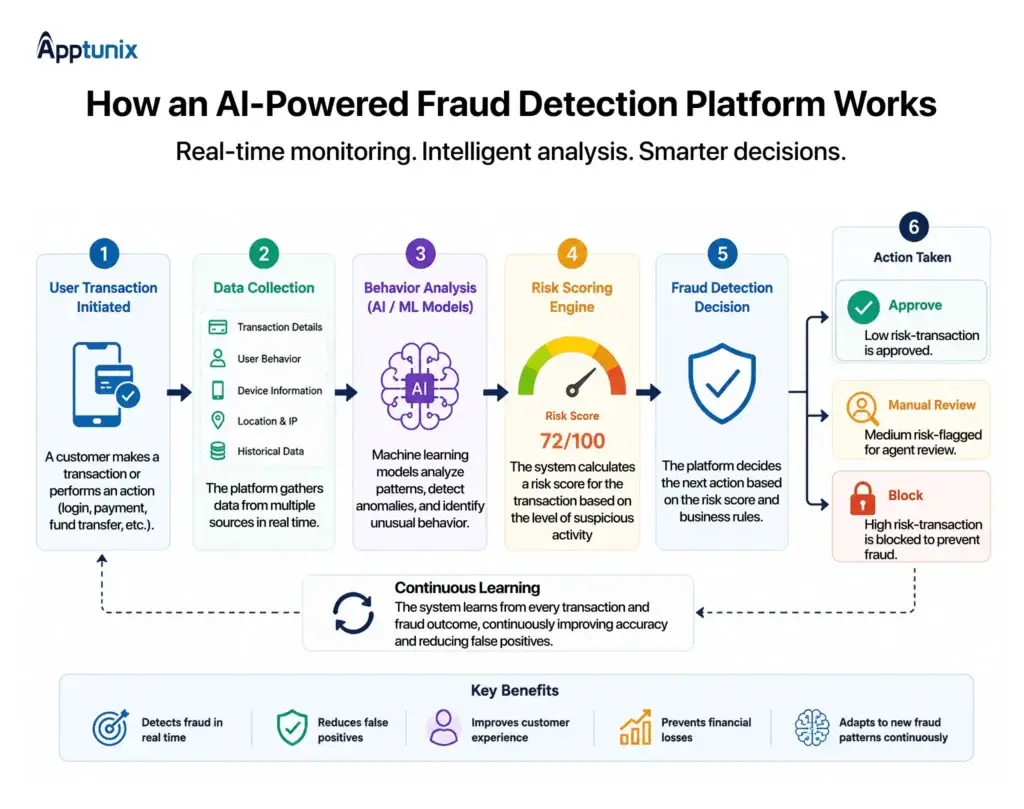
AI-driven fraud detection systems become more accurate by learning from new fraud attempts over time. This helps businesses detect threats faster while reducing false positives.
Now that we have learned how an AI-powered fraud detection platform works, it’s time to understand the development procedure of the software.
How to Build an AI Fraud Detection Platform in 2026?
You need more than machine learning models in your existing systems or new ones to develop intelligent enterprise fraud detection software.
Your enterprise requires a structured approach to detect modern fraud patterns accurately and efficiently. This can be possible with right AI development solutions, behavioural intelligence, real-time analytics, security, and continuous learning.
Let’s discover the 9 steps to develop AI and machine learning fraud detection software in 2026:
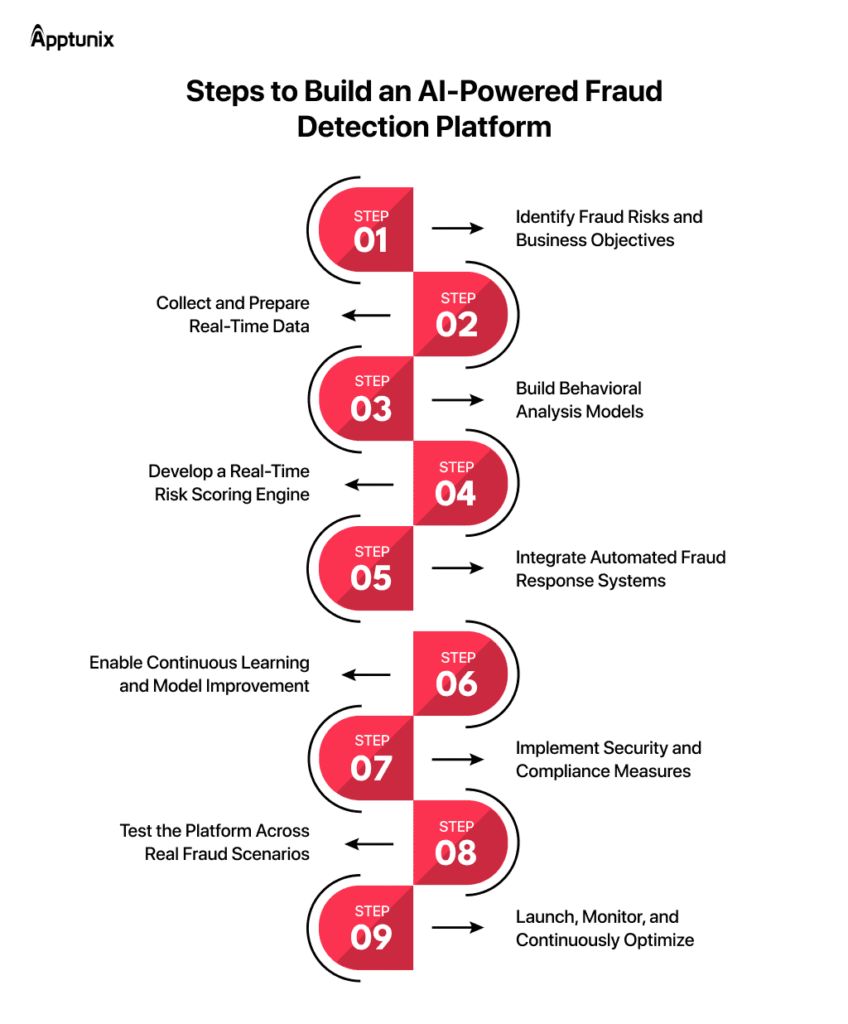
1:Identify Fraud Risks and Business Objectives
First, you must understand the type of fraud you want to prevent, which may include
- Payment fraud
- Identify theft
- Account takeover
- Insurance fraud
- Transaction laundering
- Synthetic identity fraud
Apart from that, evaluate false positive rates, fraud detection gaps, regulatory requirements, and customer friction. Having a clear understanding of business goals will help you define the platform’s accuracy, response speed, and compliance requirements.
2:Collect and Prepare Real-Time Data
Collect and organize data from multiple sources, like
- Transaction history
- Login activity
- User behavior
- Device details
- Location insights
- Payment patterns
Companies need to remove any duplicate/wrong records, detect missing data in the data set, and reshape the data to be used in training the model. Keep in mind that clean data decreases false positives, increases accuracy in fraud detection, and assists the AI fraud detection software in detecting suspicious activity.
3:Build Behavioral Analysis Models
Creating behavioral analysis models is crucial; therefore, training the system to understand normal customer behavior and to identify unusual activities is imperative. This helps in detecting suspicious spending patterns or abnormal account actions in real-time as well.
With new fraud attempts and transaction patterns, this model continuously improves over time. This results in helping enterprises detect evolving threats faster and minimize false alerts and unwanted transaction declines.
4:Develop a Real-Time Risk Scoring Engine
Developing a real-time fraud detection system demands a risk scoring mechanism that evaluates every transaction based on multiple factors like
- Behavior
- Transaction value
- Device usage
- Account activity
- Other fraud indicators
AI fraud detection software developers create an engine that instantly assigns a fraud risk score to every transaction based on detected risk indicators. A real-time risk scoring engine can automatically approve, block, or send suspicious transactions for manual review.
5:Integrate Automated Fraud Response Systems
In this development phase, the dedicated software development team set up an automated fraud response. Integrating this allows the system to instantly block suspicious activities, approve low-risk transactions, and send medium-risk cases for manual review.
It’s an important phase because it reduces manual workload for fraud teams and improves response speed during high transaction volumes. Meanwhile, businesses minimize financial losses while maintaining a smooth customer experience.
6:Enable Continuous Learning and Model Improvement
Develop an AI fraud detection software that can continuously learn from new fraud attempts, customer behavior, and investigation results. This helps the system improve detection accuracy over time.
Top fraud detection software developers create a model that helps the platform adapt to evolving fraud techniques without requiring constant manual rule updates. This allows enterprises to ensure faster threat detection and better long-term fraud prevention.
7:Implement Security and Compliance Measures
Before heading towards the testing phase, the team implements security and compliance measures into the solution. They ensure protecting sensitive financial data with encryption, audit logs, access controls, and compliance standards such as GDPR, PCI-DSS, KYC, and AML regulations.
This helps enterprises prevent unauthorized access, data breaches, and financial manipulation during transactions. Integrating strong compliance frameworks builds customer trust and reduces legal and regulatory risks.
8:Test the Platform Across Real Fraud Scenarios
In this development phase, the quality assurance team tests the AI fraud detection software using real-world fraud simulations to evaluate
- Detection accuracy
- False positives
- Response time
- System stability
Testing helps in identifying security vulnerabilities, performance bottlenecks, and integration issues before launching the system. It ensures the system performs reliably under real-time transaction loads and evolving fraud scenarios.
9:Launch, Monitor, and Continuously Optimize
Once the QA team confirms with testing, it’s time to deploy the fraud prevention software. The team helps in deploying the software and continuously monitors fraud trends, model performance, and customer behavior. The team also considers regular updates and training to help the platform stay effective against evolving fraud techniques.
Monitoring also helps enterprises identify new fraud patterns and improve system performance. It ultimately ensures the platform remains reliable, scalable, and effective as transaction volumes continue to grow.
Let’s discover some of the essential frameworks that are required to build an AI fraud detection system in 2026.
Tech Stack Required for AI Fraud Detection Software Development
Indeed, the performance of AI-powered fraud detection platforms depends on the technologies used in creating the system. Every technology layer, like secure cloud infrastructure or real time data processing, is foremost to detect fraud accurately.
Picking the right framework is important because it helps enterprises develop high performing, scalable, and secure fraud detection software. A system that can handle millions of transactions without compromising speed or accuracy.
Analyze the table to understand different types of frameworks that are required for different purposes:
| Technology Area | Required Tech Stack (Frameworks) | Purpose |
|---|---|---|
| Programming languages | Python, Java, Scala | Build fraud detection algorithms and backend systems |
| Machine learning frameworks | TensorFlow, PyTorch, Scikit-learn | Train and deploy fraud detection models |
| Frontend development | React, Angular, Vue.js | Build monitoring dashboards and admin panels |
| Backend development | Node.js, Django, Spring Boot | Handle APIs, workflows, and transaction processing |
| Real-time data processing | Apache Kafka, Apache Spark | Process live transactions and streaming data |
| Database management | PostgreSQL, MongoDB, Cassandra | Store customer, transaction, and fraud data |
| Cloud infrastructure | AWS, Microsoft Azure, Google Cloud | Deploy scalable and secure fraud detection systems |
| Big data technologies | Hadoop, Apache Flink | Analyze large-scale transaction datasets |
| Security and compliance | OAuth 2.0, AES Encryption, JWT | Protect sensitive financial and customer data |
| API integration | REST APIs, GraphQL | Connect banking systems, payment gateways, and third-party services |
| Monitoring and analytics | Grafana, Kibana, Prometheus | Monitor fraud activity and system performance |
| DevOps and deployment | Docker, Kubernetes, Jenkins | Automate deployment and system scaling |
Key Features of an Enterprise AI Fraud Detection Platform
Businesses are seeking to develop a real-time fraud detection solution that integrates with artificial intelligence (AI) to detect suspicious behavior and adjust to changing fraud trends by 2026. This is possible with advanced AI features along with basic core features. The top 10 features that must be incorporated into your fraud prevention software are as follows:
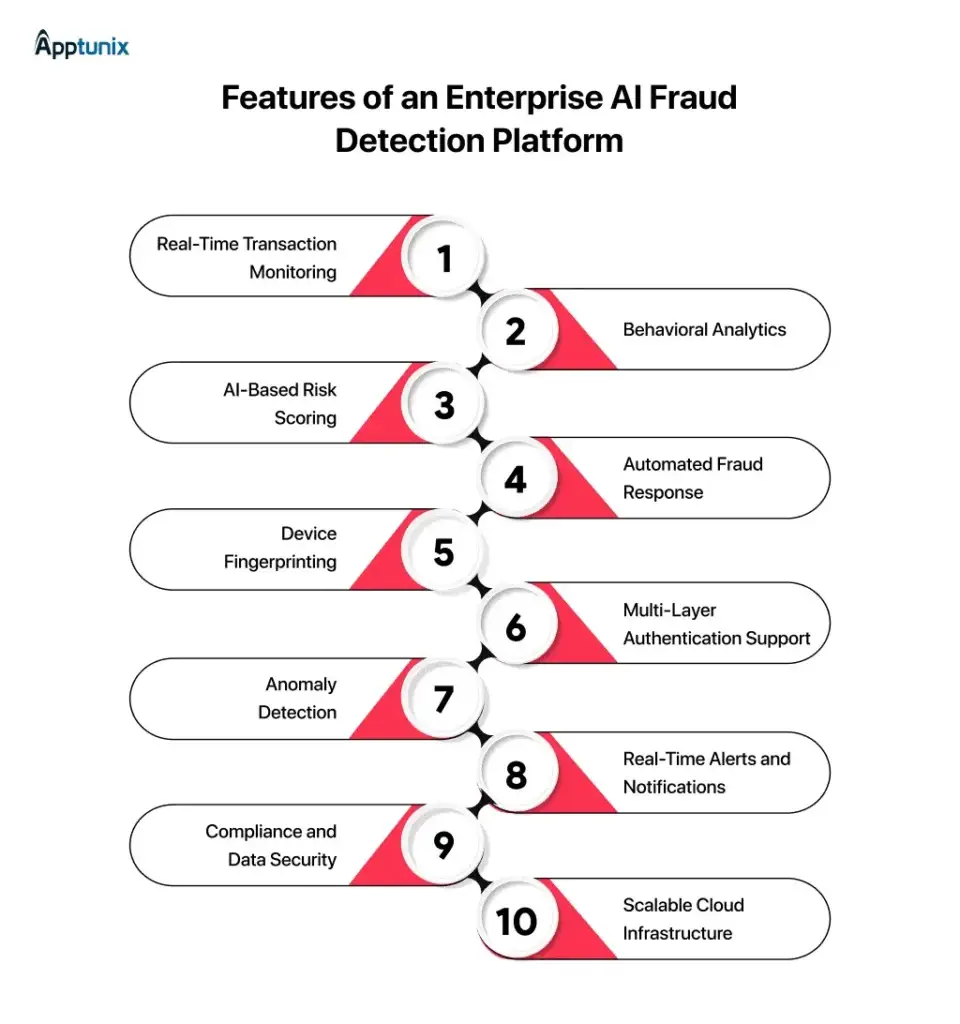
- Real-Time Transaction Monitoring
Investigates and tracks transactions and user activity in real-time for suspicious activity.
- Behavioral Analytics
Monitors and determines unusual action and spending patterns of consumers, login activity and device usage.
- AI-Based Risk Scoring
Uses fraud indicators, transaction history, and user behavior to assign a dynamic risk score to each transaction.
- Automated Fraud Response
Automatically blocks, approves or flags transactions for manual review according to the level of fraud risk profile detected.
- Device Fingerprinting
Monitors any device, browser and login activities to detect any unauthorized access.
- Multi-Layer Authentication Support
Strengthens security with OTP verification, biometric authentication, and multi-factor authentication methods.
- Anomaly Detection
Identifies hidden fraud patterns, abnormal transactions, and suspicious activities that traditional rule-based systems often miss.
- Real-Time Alerts and Notifications
Sends instant alerts to fraud teams and customers whenever suspicious activities are detected.
- Compliance and Data Security
Supports compliance standards like PCI-DSS, GDPR, KYC, and AML while protecting sensitive financial data through encryption and access controls.
- Scalable Cloud Infrastructure
Handles millions of transactions efficiently while maintaining speed, accuracy, and system stability during high traffic volumes.

Rule-Based vs AI Fraud Detection Systems
Earlier, rule-based enterprise fraud detection systems were built to detect predefined fraud patterns using fixed conditions and manual rules. But today modern fraud techniques change rapidly, which makes it daunting for static systems to detect unwanted activities accurately.
As a result, enterprises are investing in intelligent AI fraud detection software development to analyze behavior in real time and reduce false positives. Let’s discover how an AI-based system is different from the old detection system.
| Factor | Rule-Based Fraud Detection | AI-Powered Fraud Detection |
|---|---|---|
| Detection Method | Follows a set schedule and rules | Interprets behavior and transaction patterns |
| Fraud Adaptability | Only works with pre-defined fraud scenarios | Continuously adapts to new fraud techniques |
| False Positives | Higher false alerts | Reduced false positives |
| Detection Speed | But slower for more intricate frauds | Identifies unusual activity as it happens |
| Scalability | Difficult to manage at large scale | Processes large amounts of transactions efficiently |
| Maintenance | Needs regular updates to rules by hand | Opens up to new data and continually improves |
| Customer Experience | May frequently block legitimate transactions | Offers smoother & accurate verification |
Types of Fraud AI Can Detect
Today’s AI-powered fraud prevention software can easily identify suspicious activities across multiple channels, transactions, and customer interactions in real-time. The most common types of fraud AI can detect for enterprises include
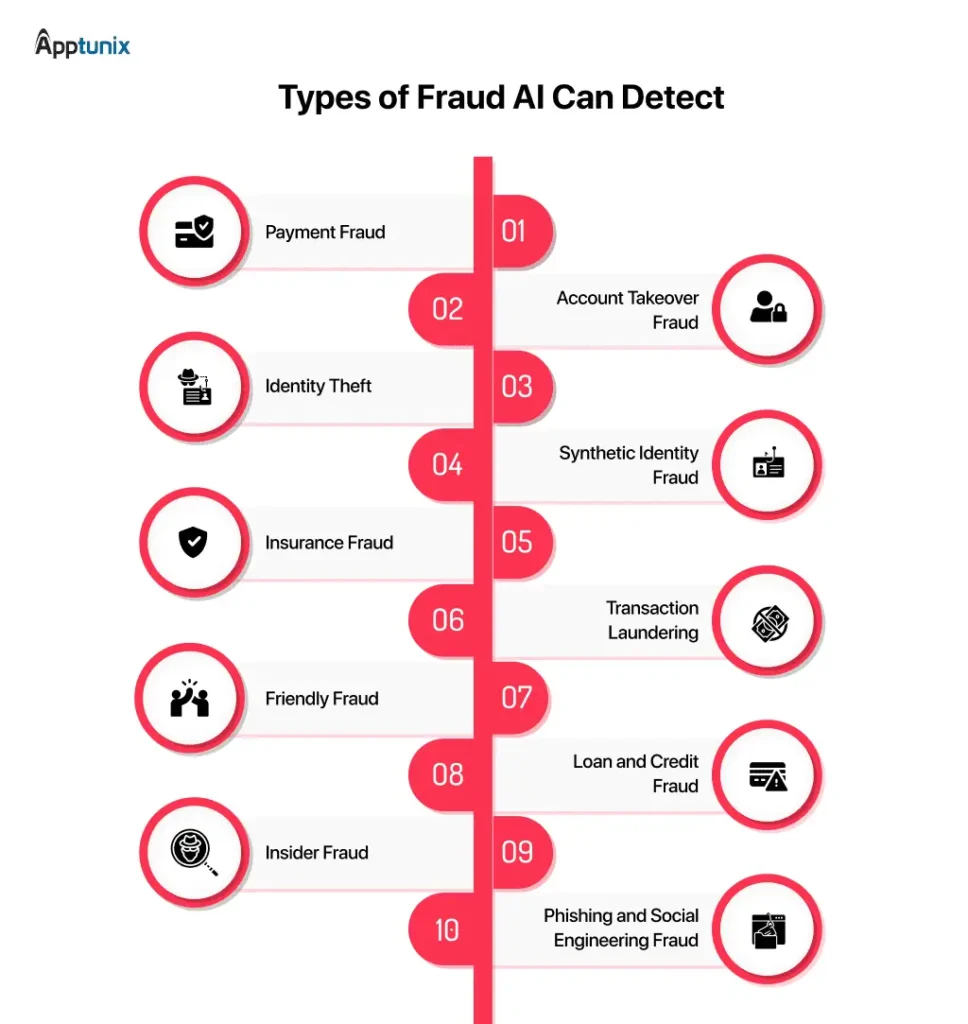
- Payment Fraud
Identifies unapproved payments to stop financial losses, stolen cards and suspicious transactions.
- Account Takeover Fraud
Detects unauthorized logon attempts, abnormal account usage, and suspicious access.
- Identity Theft
Notices when personal information is used fraudulently to open an account, make transactions, or verify accounts.
- Synthetic Identity Fraud
Recognizes fake identities using a combination of real and fake information that are used to open fraudulent accounts.
- Insurance Fraud
Identifies fraudulent claims, duplicate claims, and unusual activities of policyholders within an insurance network.
- Transaction Laundering
Traps fraudulent or illegal transactions that are executed with a legitimate merchant account.
- Friendly Fraud
Reports false charges when customers dispute legitimate charges after obtaining goods or services.
- Loan and Credit Fraud
Identifies fraud in loans, financial history, and borrower activity.
- Insider Fraud
Detects any unusual employee behaviour, activity or access to sensitive financial systems or systems, or any other internal misuse.
- Phishing and Social Engineering Fraud
Detects unusual behavior patterns linked to compromised accounts and fraud attempts caused by phishing attacks.
How Much Does AI Fraud Detection Software Development Cost?
As of 2026, the cost to build fraud prevention software is estimated between $80,000 and $300,000 or even more, depending on the complexity of the project. The pricing also depends on
- AI model complexity and training
- System architecture and integrations
- Regulatory and compliance requirements
- Development team and timeline
- Deployment and ongoing maintenance
Analyze the table below to understand the cost estimate based on complexity:
| Software Complexity | Estimated Cost | Estimated Timeline |
|---|---|---|
| Basic Fraud Detection Platform | $50,000-$80,000 | 3-4 months |
| Mid-Level Fraud Detection Platform | $80,000-$200,000 | 4-8 months |
| Complex Fraud Detection Platform | $200,000-300,0000+ | Up to 1 year |
Conclusion
You understand that enterprises now no longer rely on outdated rule-based systems that struggle to detect modern threats as financial fraud continues to grow.
This is making enterprises invest in AI fraud detection software development so that they can identify suspicious activities faster and improve customer trust. All this happens without compromising security.
However, developing an effective fraud prevention system is not only about detection accuracy. Enterprises also need strong governance, compliance, transparency, and responsible risk management to ensure long-term reliability.
With the right technology strategy and AI governance company, like Apptunix, for building fraud detection software in place, you can stay resilient against evolving financial threats while maintaining operational efficiency and customer confidence.
Apptunix helps enterprises by developing secure, scalable, and governance-focused AI solutions tailored for modern fraud prevention needs.
So don’t get behind. Use the full potential of AI to detect fraud and prevent your company from big losses.


